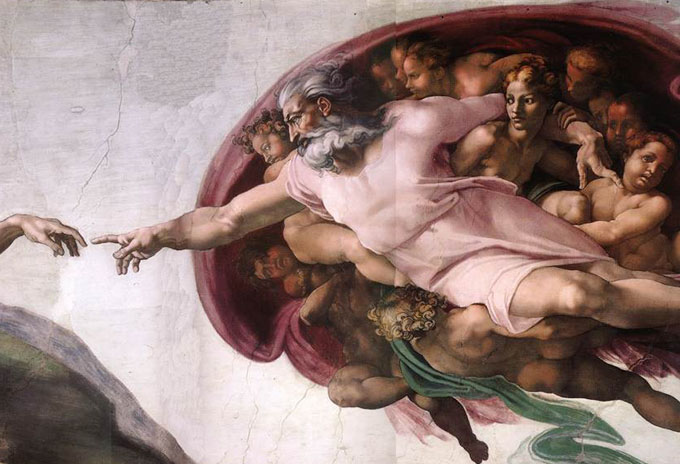
The first pillar of political thought is the most defining of all the pillars. Who’s in charge? The Nature of Authority.
As I studied the principles of conservatism and progressivism it wasn’t hard to draw out what each worldview believed and compare and contrast the two. It wasn’t until I began putting those differing beliefs into a hierarchy that it all started to make sense.
Very quickly it became obvious that the most defining presupposition of political thinking was The Nature of Authority. Who is the ultimate authority? There are really only two options 1) God, or 2) Man. This is a watershed issue because it will impact all the other pillars, if one is consistent in their thinking. The nature of authority, God or Man, is like the continental divide when it comes to one’s political leanings. If a drop of water falls on the left side of the divide it runs into the Pacific, and if it falls on the right it runs into the Atlantic. If you believe ultimate authority resides in God you should, and I say should, hold to certain beliefs about reality. If on the other hand you believe ultimate authority is in the realm of man you should hold a very different set of beliefs about reality.
This isn’t necessarily a Theist versus Atheist thing. It’s a who’s in charge thing. If you don’t believe God exists then it’s hard to give God the ultimate authority, but not impossible. It’s just more complicated. William Dembski, for example, is an atheist, but is squarely on the side of intelligent design as the best explanation for the universe and reality we see. He acknowledges a designing intellect but stops short of calling it God. Douglas Murray is another atheist, who can’t conclude God exists, but does recognize there is an authority external to and above man. Both of these men, although atheists, would be in the same camp as those of us who believe God is the ultimate authority, but manage to do it without invoking God.
Likewise, someone can believe in God, but give ultimate authority to man. The best example I can point to are progressive Christians. The adjective “progressive” is the first and most obvious clue. I think most progressive Christians believe in God, but when push comes to shove, ultimate authority is with man. We are in charge. We determine our destiny. We create reality.
The first question you need to ask yourself when you have a political disagreement is, “Who is this person giving ultimate authority to? God or Man?”
But Who’s Right?
The next question we need to answer regarding this pillar is, who’s right? I would love to be able to tell you God without question exists and is the ultimate authority. But I can’t. What I can say, and will explain, is that God is the best explanation for all reality and therefore is the ultimate authority in the universe. Either God did it, or everything is the result of natural processes. Those are the only two real choices. Regardless of where you or someone else falls on the issue of authority there are 5 features of reality that need to be explained to determine ultimate authority, 1) the beginning of the universe, 2) the fine tuning of the universe, 3) life, 4) human consciousness and intelligence, and 5) the appearance of objective morality.
Before I go into any arguments for God’s authority, a couple of notes. First, this is not going to be a comprehensive treatment of the questions. It will be sufficient to make a reasonable person at least consider God as the ultimate authority and give you some questions you can ask someone who is genuinely interested. Second, all I’m trying to accomplish with the below explanations is making God a more reasonable conclusion than the other possibilities.
- Beginning of the universe: William Lane Craig has developed what he calls the Kalam Cosmological argument (KCA). It goes like this: 1) Everything that begins to exist has a cause, 2) The universe began to exist, and therefore 3) The universe has a cause. A simple deductive argument. Now the question becomes, what is that cause? We really have two choices. 1) an immaterial, spaceless, timeless, all powerful, all knowing, personal being, which we call God, or 2) Nature. But a couple of issues arise with the latter. First, have you ever seen something create itself? All scientists agree, all space, time and matter began to exist around 14 billion years ago. There was nothing. Not a thing, nada, universal negation. So how could nature or matter create itself? It’s not magic, because at least with magic you have a magician and a hat.
On the other hand, even if the idea of God as a being seems implausible, at least the God as described earlier is adequate to the task of creating the universe from nothing.
Questions for consideration:
- Has anyone ever seen something created from nothing? (God is not nothing and He wasn’t created by definition)
- How could nature or matter create itself?
- The attributes of God are typically a spaceless, timeless, immaterial, all powerful, all knowing, personal being. Wouldn’t a being like that be more than capable of creating our universe?
- God or nature? Which explanation seems more reasonable?
2) The fine tuning of the universe:
Our universe is exquisitely fine tuned for intelligent life. One conservative calculation puts the chance of our fine tuned universe to be 1 chance in 10^120th power. There are only 10^89 elemental particles in the universe. You would have a better chance picking a specific single particle from the entire universe than having a universe fine tuned for life. It’s not like the lottery where someone is going to win. It’s like you winning a 1 number lottery with 10^120th balls.
Again, there are only 2 real choices: 1) Design, or 2) Chance. Either someone or something rigged the lottery for us to win or we just got truly unbelievably lucky. Some will try to throw in a third option, the multiverse, but other than the movies, there is no evidence for that explanation. So, given the astronomical chances of a fine tuned universe, which is more reasonable, design or chance?
Questions for consideration:
- Do you know what the chances of a life permitting universe are?
- How do you explain our incredible, our unbelievable chances?
- Wouldn’t an all-powerful, all-knowing, personal God be able to rig the game for a life permitting universe?
- Which seems more likely, God or Chance?
3) Life:
As living organisms we take this one for granted, but the chances of life forming without help are similar to our fine tuned universe. Douglas Axe applied probability theory to the formation of a single functional protein and calculated it to be 1 in 10^164. The main criticism of his calculations is that evolution can improve those odds. Do you see the problem with that critique? Evolution, by definition, requires life for the theory to work. Before life can even be possible you need as many as 20 different functional proteins. Uh oh! Furthermore, James Tour, a highly esteemed molecular biologist, has challenged origin of life researchers. He will give them all the necessary matter needed to make a cell and has wagered, they still won’t be able to create a living cell. That’s because life requires information, lots of it, and very specific information. Complex Specified Information (CSI). Complex meaning it isn’t random. Specified means it can be read, interpreted, and instructive. A single strand of human DNA contains 800 megabytes of data and there or about 3,000 trillion strands of DNA in the human body. And, it’s not random information. The information encoded in DNA builds functional proteins, turns on and off certain processes throughout our lives. But wait, there’s more. There is also epigenetic information. As I understand it (Stephen C. Meyer forgive me if I’m wrong) epigenetic information is a layer of regulatory information beyond the DNA sequence. It is a type of information that regulates the timing and expression of the DNA.
Questions for consideration:
- Evolution may account for the survival of the species , but how do you account for the arrival of the species?
- Where did all the information for living organisms come from?
- Where do we always see information coming from? (A mind)
- Considering all the components and information required for life, which is a better explanation for life, God or Nature?
4) Human Consciousness and Intellect:
It’s ironic that we rarely use our consciousness and intellect to contemplate our consciousness and intellect. Let’s do that now. Fossil evidence shows us modern humans showed up around 300,000 years ago, but the split with other hominem species could be as long as 500,000 to 600,000 years ago. Yet, complex culture, art and language can only be traced back to between 50,000 to 100,000 years ago. What was it that gave rise to the unique creatures we are, what makes us human? First, consciousness. It is the ability to self-reflect, to feel emotion, to think, to perceive, to interpret sensory data and turn it into information. Second, intellect. The ability to solve problems, think abstractly, learn, process, see patterns. It works in conjunction with our consciousness to create art, write, and speak.
This is not the brain. Our minds (consciousness and intellect) and brains work together, but are separate and different things. The brain is the material thing, and the mind is an immaterial thing. Our brain has a physical location, it has dimensions, weight and is subject to chemical processes. Our mind doesn’t have a physical location and has no dimensions. It is immaterial. Think about your first memory as a child. It takes up no space in your brain, but your brain reacts to the memory with electro-chemical changes. When you stop thinking about that memory it goes away, not forever, but it vanishes. Where did it go, where did it come from?
Neuroscientists are maybe the best qualified people to comment on the distinction between the brain and the mind. Dr. Wilder Penfield started his surgical career as materialist but after thousands of surgeries he concluded the mind was an immaterial thing separate from the brain. During his surgeries his patients were often awake and he found with the proper stimulation he could make arms move, he could make them feel physical sensation, he could even elicit memories. However, he could never stimulate abstract thinking, he could never make a patient believe something they knew wasn’t true. Although he could operate on the physical brain, he could never get to the immaterial mind.
So the question becomes, how did this immaterial mind arise in humans? Again, have we ever seen material objects create an immaterial thing? What would be capable of creating something that complex, which is immaterial. Seems to me only an immaterial, all knowing and all powerful being could do something like that.
Questions to consider:
- The human body plan has been around a lot longer than the human mind. If humans are just matter, why did it take so long for the mind to become apparent?
- If the mind is a material thing, where are your thoughts, your memories, your emotions?
- Has anyone, anywhere ever seen matter, create something immaterial?
- Isn’t it more plausible that an immaterial, all-powerful and all-knowing being created the mind than some unknown, unidentified material process?
5) Objective Morality:
I think it’s safe to say we all agree the world isn’t how it’s supposed to be. Something, or a lot of something’s are wrong with the world and other people (it’s never us). Where do we get this sense that something’s wrong?
We are once again, and for the last time are going to try and answer one of life’s big questions, where do we get this sense of right and wrong? Unlike the other features of reality needing to be explained, this one has a multitude of explanations. Some are good, some are bad. Some say it’s all social convention. Some say it’s evolution. Some say it’s written on our hearts.
Unlike the other features of reality we aren’t going to be able to solve the appearance of objective morality using probability, we are going to need to employ logic and reason. First, it will be useful to understand the difference between objective and subjective. Objective facts are independent of, or external to the mind. Subjective facts are dependent on, or taking place in a person’s mind. Outside versus inside. External versus internal. So when I write about objective morality, I’m writing about a morality whose source is external to humans. Its source isn’t from the human mind or minds. For example, the unjustified taking of an innocent human life is wrong. We don’t need to be taught that, we all know it. It was wrong from the beginning of time and it applies to everyone that has ever lived. Those are the features of objective morality. Timeless, universal, external, and we are obligated to follow. We are going to have a much longer discussion on this topic in the next pillar-The Nature of Truth, but for now we’ll confine our discussion to just morality.
So, what about the other options some have floated like social contract, human flourishing, or evolution? Here’s a couple of things to think about. If a majority of a society is all it takes to create morality then all social progress is impossible. If it’s the opinion of the majority that creates what’s good and bad then Dr. King and Rosa Parks were morally wrong to engage in civil rights protests. After all, a majority of Americans believed European ethnic groups were superior to all others. Their internal, subjective beliefs would be all that’s necessary for segregation to be considered “good”.
Other issues like slavery and the Holocaust wouldn’t be considered wrong because a majority of society subjectively felt they were acceptable or good. Slavery and segregation didn’t suddenly become wrong because a majority of people were convinced they were wrong. They were wrong from the beginning and we only believed otherwise because of hard hearts and selfishness. Those things are objectively wrong.
Evolution is also offered as a way to achieve objective morality, but it fails too. If right and wrong, good and bad are byproducts of the evolutionary process then how do we hold someone accountable for wrongdoing? After all they just evolved with a different set of moral values and beliefs. It’s not their fault. That’s just ridiculous.
For moral laws to exist there must be a moral law maker. A law maker that has the proper nature, authority and knowledge to make those laws…God. William Lane Craig to the rescue again with a very simple, yet powerful argument for God from the existence of objective moral values and duties. 1) If God does not exist, objective moral values and duties do not exist, 2) Objective moral values and duties do exist, therefore 3) God exists.
Questions to consider:
- We all agree that certain things are wrong with the world. Why do you think there is such widespread agreement on those things?
- If you think evolution explains objective moral values and duties, could we have ever evolved in a way that rape or murder were okay? Why not?
- If moral values and duties are based on human flourishing, who decides what “flourishing” means? And why human flourishing and not planetary flourishing? Who says what’s good and bad for humans? Hitler thought humans would flourish by exterminating Jews, Gypsies, and the handicapped. Using that explanation why was Hitler wrong?
- If widespread agreement on moral values and duties is the source of objective morality then wouldn’t things like the abolition movement and the civil rights movement be considered wrong? Or are slavery and segregation always wrong and it was us who had it wrong?
- Doesn’t it make more sense that there exists a being who is perfectly moral by nature, and who has the authority and knowledge as the source for objective morality?
This is a cumulative case for the existence of God. By themselves one might be able to resist or ignore the individual arguments. But when taken together it seems to me there is a pretty good case that God exists. And if God exists and created the universe and all it contains it seems to me God has the authority and is the authority we should all be looking to for instruction on how to best organize our lives and our world.